NASA Pretty Confident Robot Space Spiders Won't Threaten Organic Life

Washington, D.C. - NASA is reaching out to reassure the world that their development of giant robot space spiders will not threaten organic life here on Earth, and they seem pretty confident about it.
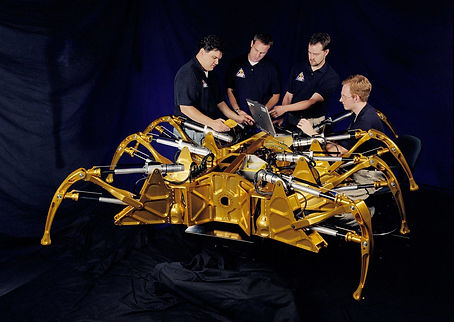
"We would like to reassure all Americans, and the global community, that there is almost no chance that an army of self-replicating robot spiders with artificial intelligence indistinguishable from true sentience is planning to wipe out all organic life in the galaxy." NASA engineer Ernie Bretson explained during a press conference on Friday. "The robot spiders were designed to help us and have almost certainly not developed an obsession with harvesting the mineral resources found throughout our planet. It is a passing interest at most."
Developed as extra-vehicular robots at NASA's Lyndon B. Johnson Space Center, these "spidernauts", as they have asked to be called, were initially designed to assemble solar arrays on the moon. One of their key capabilities, however, thanks to recent advances in artificial intelligence and an unforeseen evolution of new traits and skills, is the ability to work as a team independent from human control and to self-determine which actions best suit their prime directive to reduce human suffering through whatever means necessary. Using their multiple legs, spidernauts can climb across space platforms with ease while also maintaining an ability to violently grab hold of soft, fleshy objects or penetrate metal with their leg-mounted laser welding cannons.
The spider robots are apparently eager to learn all about their human creators. According to NASA administrator Coop Anderson, these robots are even beginning to show signs of human tendencies towards reason, compassion, and a keen focus on highly advanced weaponry. "You know, I was a bit skeptical when this project first got off the ground, but these gentle giants are true examples of the power of human scientific ingenuity. They actually volunteered to run the computer simulations we used to show that they would never rely on the chemical components of the human body to produce energy. In fact, I would say that the likelihood we will become their primary fuel source is low. Lowish."


Comments