Chiropractic Paleoanthropologists Discover Neanderthal Subluxations

Port Orange, FL - Shocking the scientific community today, and perhaps taking the first steps towards a new theory on the history of human evolution, chiropractic paleoanthropologists working at the Institute of Chiropaleoanthropological Studies (ICS) announced the discovery of several vertebral subluxation complexes in the well-known Kebara 2 and Shanidar 3 Neanderthal spine specimens.
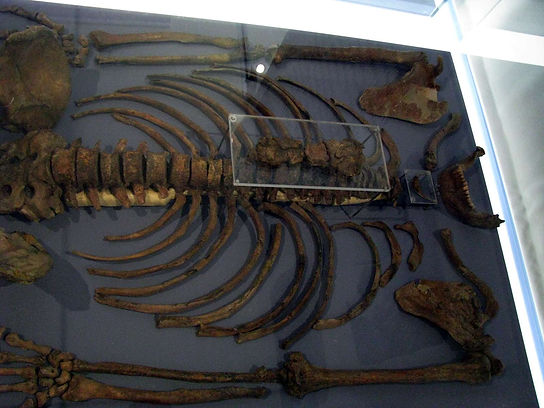
"This report is the culmination of several months of painstakingly detailed research," chiropaleoanthropologist and lead researcher Frank Grimes explained. "Not only did our highly trained team of experienced field chiropractors employ gentle palpation of the spine in each of the two sets of fossilized remains in order to diagnose each lesion, but the specimens were also further analyzed by full spinal x-rays, surface and infrared electromyography, thermal scanning, leg length measurements, and that thing where we hold babies upside down for some reason. We didn't want to leave anything up to chance."
After a consensus vote confirmed their findings, the team set out to explain why the C-4, C-6, T-2, T-8, L-4, and L-5 vertebrae were affected in the two Neanderthals. Weeks of frustration and several hypothetical dead ends led to the involvement of Arthur Fernandez, a chiropractor who specializes in the science of Applied Kinesiology. This would prove to be a key component of the unraveling of this prehistoric mystery.
Applied Kinesiology is a cutting-edge diagnostic tool rooted in precise muscle testing as a means of assessing a patient's structural, chemical, and emotional health. According to Fernandez, who chose to specialize in the scientific discipline after a chiropractor uncovered a connection between his occasional headaches and a molybdenum deficiency by measuring the strength of his iliocostalis lumborum muscle before and after sticking his hand into a bucket of lentils, Applied Kinesiology was developed in the 1960s by Dr. George Goodheart. "He discovered the concept that specific muscles correspond to particular organs or body systems. Testing muscle strength or weakness when exposed to certain stimuli or interventions helps to identify imbalances, dysfunctions, and deficiencies."

"Chiropractors aren't used to working with patients that are already dead," Fernandez revealed. "But we do take care of children, animals, and sometimes trees or sturdy bushes. When I realized the connection, the similar inability of both dead people and infants or circus elephants to talk, it hit me...hard. Surrogate testing was the answer."
Using the chiropractor's intuition built up over decades of clinical practice and three weekend seminars at the airport Howard Johnson in Newark, Fernandez placed his hands on a segment of Neanderthal spine and tested his own muscle strength while holding a variety of vials holding substances potentially toxic to Neanderthal physiology:
When I noticed that my arm felt weak as soon as I grasped the bottle of mercury, I couldn't help but think of the irony. The very same substance that has damaged so many young children after routine vaccinations also used to wreak havoc on this ancient population of monkey-human hybrids."
With a diagnosis and an etiology in hand, the team from ICS decided to go public with their findings. And though they are all just very excited about the potential for future discoveries, team leader Grimes has unearthed a more melancholic interpretation. "Just thinking about how an entire species was wiped off the face of the Earth because chiropractic healing techniques were discovered 30,000 years too late is a little unsettling. I'd hate to see the same thing happen to us."


Comments